India's gene data
is stuck in WhatsApp
photos.
Pharmacogenomic results in India arrive as PDFs and phone photos, and stay there. Pathya reads each one with Muse Spark, quotes every call, standardises it with PharmCAT, removes identifiers, and adds it to a cohort researchers can count.
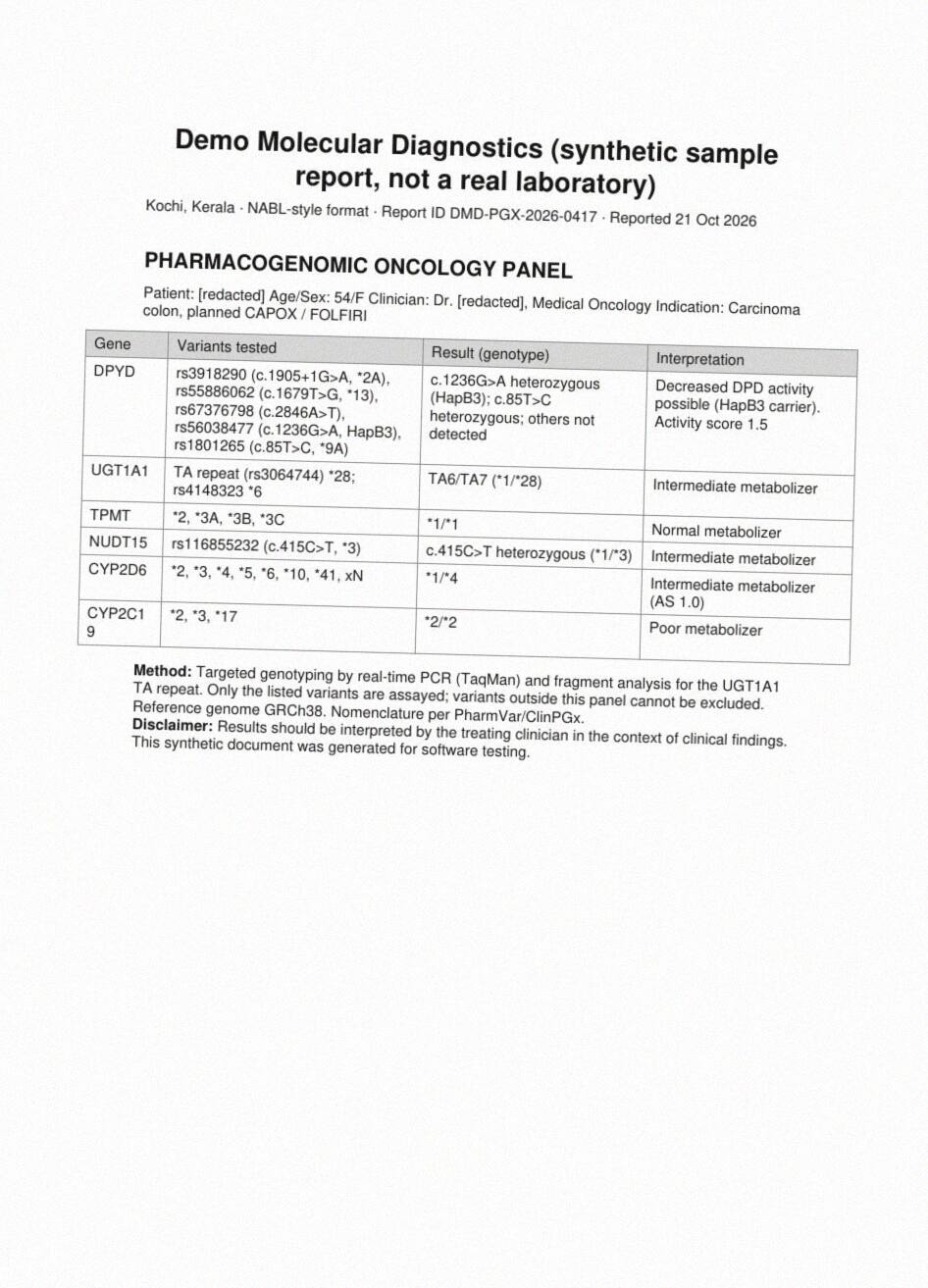
This synthetic Indian-panel report, photographed skewed and noisy like a WhatsApp forward, is what the button reads. About 30 seconds, or open a finished record. Research tool, not medical advice.
- 1InputReport inPDF, WhatsApp photo, voice or VCF
- 2Read every callverbatim quotes, strict schema
- 3PharmCATStandardisePharmVar alleles, CPIC phenotype terms
- 4RulesQuality checksIndia panel coverage, identifier removed
- 5OutputResearch recordJSON · TSV · CSV, joins the cohort
- 6HumanCurator verifieseach call against the source
01 · The gap
The test was done.
Nobody counted it.
Pharmacogenomic tests are already being run in India. The results are correct, and almost none of them reach a dataset.
A lab in Kochi
A DPYD result is issued
Panel genotyping, printed as a PDF: DPYD c.1236G>A heterozygous (HapB3). A photo of it goes to the hospital on WhatsApp.
Then
It stays in a phone
The result lives in a chat thread and a paper file. No registry ever sees it, so it never counts towards what India knows about its own variants.
The result
India's evidence stays thin
Indian DPYD frequency data rests on two studies of about 2,000 and 1,612 people. There is no ICMR guideline on DPYD testing, and the variant most Indians carry, c.85T>C, is still an open question.
With Pathya, under a minute
Every report becomes a counted record
The photo is read and each call quoted from the page, standardised to PharmVar names, stripped of identifiers, checked for panel gaps, and added to a cohort with confidence intervals. A curator verifies it against the source.
- Illustrative, built from the synthetic demo report. Figures: PMID 33105068, PMID 40810747, PMC11300675.
Why the data matters
of fluoropyrimidine deaths are in DPYD variant carriers, who are about 4% of patients
Sharma 2021
of Indians carry DPYD c.85T>C. CPIC calls it normal; South Indian cohorts report a toxicity signal
Indian national guidelines on DPYD testing
ICMR / NCG, none found
02 · The population
India carries a different risk.
CPIC's DPYD tables were built on European data. In Indians the decreased-function variants are different, and the most common variant has an effect nobody has settled. Change the view.
- 33HapB3 carriers, the most common Indian decreased-function variant
- ~2*2A carriers, the classic European variant, rare here
- ~21rarer decreased-function variants only sequencing finds
- ~250c.85T>C (*9A). CPIC: normal function. South Indian cohorts report a toxicity signal: an open research question
Per 1,000, rounded from PMID 40810747 (WES, n=1,612) and PMID 33105068 (n=2,000). Groups can overlap in real patients.
03 · The system
The model reads.
The record is verifiable.
Muse Spark reads the page and quotes each call; Muse Voice takes results read aloud in Malayalam or English. PharmCAT standardises the names, rules check panel coverage and remove identifiers, and every step is logged. Nothing in the record is advice.
04 · The proof
Tested on reports
it had never seen.
Thirty-six synthetic Indian lab reports, as clean PDFs, phone photos and the kind of skewed, shadowed photo that arrives over WhatsApp. Every gene call scored against the truth.
Reading the lab report
177 gene calls · 36 reports · exact diplotypeClean PDF
Phone photo
Harsh photo: skewed, shadowed, compressed
Open weights, same answers
Muse Spark Open, run on Baseten, matched hosted Muse Spark call for call. A lab or biobank can run the reader on its own servers, so genomic data never leaves the building.
gene calls on held-out reports, open-weights model
Open dataset. IndiPGx-Read v0.1: 72 synthetic Indian lab reports with ground truth (4 layouts × 3 renders × 2 sets) and the scoring harness, in the public repository.
Held out. New genotypes and new photos, generated with a seed the pipeline was never tuned on, in four layouts Indian labs use: star table, rsID table, narrative, variant checklist. The OCR baseline was written knowing every layout, so this is its best case. Real lab formats will be harder; de-identified reports from a partner lab are the next test.
Found along the way: two real bugs on the development set, fixed before the held-out run.
05 · The cohort
One report is a result.
A thousand are evidence.
Every record joins a cohort: carrier frequency per India-relevant variant, with a confidence interval, and a count of the panels that never tested it.
Demo cohort, live
loading… · synthetic reportsCounted honestly. A report whose panel never named a variant is left out of that variant's denominator, not counted as a non-carrier. Intervals are Wilson 95%.
Ready for a study. One CSV, one row per record, PharmVar names. No patient identifiers, no advice.
Open the cohort06 · Your turn
Build a record. Watch it read.
Upload a report or a photo, read the results aloud, or pick a sample. Every step streams from the server as it finishes.